
Skip to content

Price scraping software solutions for retail price intelligence

Collect accurate competitor pricing data across 34 markets, match 119M+ data points monthly, and feed clean market intelligence directly into your AI retail pricing decisions — all with 98% SLA-backed data accuracy.
Talk to expert
hero-image

Why pricing data quality has become a competitive edge

Enterprise retailers today manage tens of thousands of SKUs across online, offline, marketplace channels, and competitors, while repricing is carried out multiple times per day. As a result, the volume of available competitor pricing data has never been higher. However, high-volume data without accuracy provides no advantage and is instead a liability.

The real challenge is not having access to data but rather having pricing information that is reliable. This is important because data quality errors, such as incorrect product matches, can lead teams to compare products that are not equivalent. A missing price context (e.g., whether a price reflects a promotion, an out-of-stock item, or a regional variant) makes the comparison meaningless even when the match is correct, while coverage gaps leave entire competitor sets or geographies unmonitored. These errors usually occur silently and compound over time, as pricing teams rarely know when a product match is incorrect or important market context is missing. This means that the pricing strategies and execution built on that data may also be inaccurate, as the data itself.

Pricing data quality has become a direct competitive differentiator. The enterprise retailers that have access to accurate, timely, and comprehensive data are better positioned to identify pricing opportunities, respond better to market changes, and make more confident pricing decisions at scale. 

info

What is price scraping software?

Price scraping software is a tool that automatically collects competitive pricing data online. Retailers use this software to help monitor competitor prices, promotions, product availability, shipping costs, and other market signals at scale. Instead of manually checking through hundreds of product pages, this software uses a price crawler to continuously gather pricing information and deliver it in a structured format for analysis.

The operation of modern e-commerce pricing scraping solutions goes beyond basic data collection. They have product matching capabilities that connect competitor products to the correct SKUs, allowing retailers to compare equivalent items across different websites and marketplaces. This helps to create a base for a more accurate foundation for retail price intelligence and competitive analysis.

Price scraping software effectively combines web scraping for pricing, product matching, and market monitoring to help retailers maintain visibility into competitor activity and make more informed pricing decisions in rapidly changing retail environments.

Pricing data challenges enterprise retailers face

The collection of accurate market intelligence at enterprise scale is often more challenging than simply deploying a price scraping solution. While large retailers can leverage e-commerce price scraping software and other forms of web scraping for pricing to collect vast amounts of competitor pricing data, gathering information is only one part of the process. To support effective pricing decisions, the collected data must also be accurate, comprehensive, and actionable.

As enterprise retailers expand across larger product assortments, competitor networks, channels, and geographic markets, there are certain challenges that can restrict their ability to achieve these data standards. These challenges at different stages of the data collection and analysis process create gaps between raw market data and actionable pricing intelligence.

Stale data leads to stale pricing decisions

Competitor prices, promotions, and product availability can change multiple times throughout the day. When competitor pricing data is not frequently collected, retailers may end up making decisions based on information that no longer reflects actual market conditions. 

As pricing environments become more dynamic, enterprise retailers require more than periodic data collections. It is required that effective price monitoring software should be capable of providing timely and reliable market intelligence that allows pricing teams to react quickly and confidently to changing conditions instead of relying on outdated information.
How Competera solves this
Competera’s competitive data solution continuously collects and validates competitive market information across competitors, channels, and markets. Its SLA-backed data quality and frequent updates make it a pricing intelligence tool that allows enterprise retailers to make faster and more informed pricing decisions.


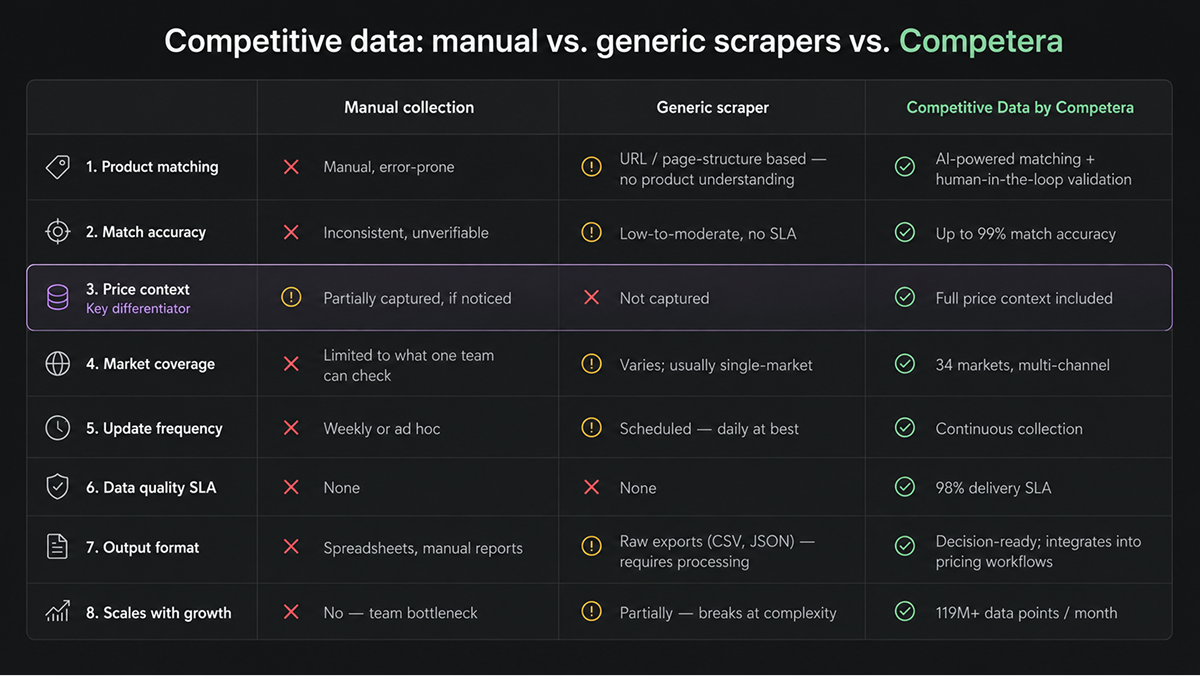
Generic scrapers don't match products — they match URLs

Generic price scraping tools usually identify products based on webpage structures, URLs, or basic product attributes instead of establishing accurate product matches. Retailers expanding across larger product assortments, competitors, and marketplaces can make it difficult to compare equivalent products and maintain competitor pricing data. 

For enterprise retailers that manage thousands of SKUs across multiple competitors and markets, inaccurate product matching can distort price comparisons and create a misleading view of the competitive landscape. Having an accurate competitor analysis requires reliable product matching capabilities that can connect equivalent products across competitors and marketplaces to ensure meaningful price comparisons and stronger pricing decisions. 
How Competera solves this:
Effectively combines AI-powered product matching with human validation to identify both exact and similar product matches across retail markets.

Coverage gaps create blind spots

Most price scraping tools and ecommerce data scraping processes only monitor a limited set of competitors, products, marketplaces, or geographic markets. As retailers expand across multiple channels and regions, these coverage gaps limit visibility into competitors’ activity and fast-changing market conditions. 

An incomplete view of the market can cause retailers to overlook pricing opportunities, react slowly to competitor changes, and make decisions based on partial intelligence.
How Competera solves this:
Competera’s price crawler software collects competitive data across 34 markets and supports flexible monitoring across products, competitors, and regions. This helps enterprise retailers to reduce blind spots and maintain broader visibility into market conditions.

Scraped data sits in dashboards instead of driving decisions

While many retailers invest in price scraping tools and website price scraper solutions to collect large volumes of competitor pricing data, the value of that data is often limited when it remains isolated within dashboards, spreadsheets, or reporting systems that are disconnected from day-to-day pricing workflows.

As pricing operations grow across thousands of products and multiple competitors, there is a need for more connected workflows that can transform competitor pricing data into actionable recommendations that help pricing teams respond faster and make more confident decisions at scale.
How Competera solves this:
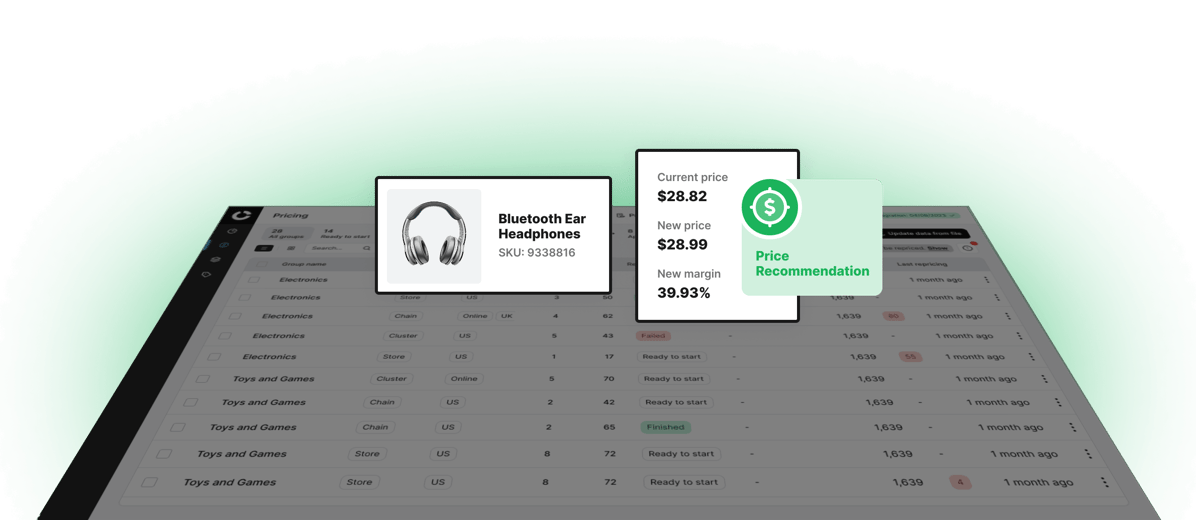
Competera combines competitive market intelligence with AI-driven pricing recommendations that help retailers move from data collection to pricing execution. It integrates competitive data directly into its pricing platform, allowing pricing teams to turn insight into faster and more informed pricing decisions.
Competera
cta-banner-bg

Learn more about Competera’s technology

Combine competitive-driven pricing decisions with value-based pricing powered by multi-dimensional elasticity modeling

How Competera's price scraping works

Competera’s price scraping solution uses AI and machine learning capabilities to help retailers collect, validate, and analyze competitor pricing data at enterprise scale. It operates through a structured workflow that helps to ensure that the collected data is accurate, relevant, and ready to support pricing decisions.

Step 1: Competitor identification

Competera’s solution starts the price scraping process by identifying the competitors, marketplaces, and sales channels that are most relevant to each retailer’s category structure and market position. Competera’s competitive identification capabilities are designed to ensure that the price scraping activities are focused on the sources that matter most. 

This targeted approach helps to improve the quality of competitor pricing data collected through e-commerce price scraping while creating a stronger foundation for retail price intelligence and more accurate competitive analysis.

Step 2: Web crawling across 34 markets

Once the competitors have been identified, Competera’s price crawler software starts a continuous collection of competitor pricing data across 34 markets. The crawling process involves tracking prices, promotions, product availability, shipping information, and other market signals across competitor websites, marketplaces, and digital sales channels. 

Competera uses e-commerce data scraping and custom crawling infrastructure to gather competitive market data at the frequency and scale that is required by enterprise retailers. This creates a constantly updated stream of market intelligence throughout the pricing process.

Step 3: AI-powered product matching with human-in-the-loop validation

After data collection, Competera applies AI-powered product matching to connect competitor products with the correct products in a retailer’s portfolio. The matching process evaluates product attributes, specifications, descriptions, and other relevant data points to identify both the exact and similar product matches across competitors and marketplaces. 

To improve matching accuracy, Competera combines automated matching algorithms with human-in-loop validation. This helps to ensure that the competitor pricing data is linked to the right products, creating a more reliable foundation for retail price intelligence and competitive analysis. 

Step 4: Multi-level data validation

Competera applies multiple layers of data validation to verify the accuracy and reliability of the collected information before it is delivered to the retailers. This process serves to identify inconsistencies, incomplete records, duplicate entries, and other data quality issues that can affect pricing analysis.

Step 5: Direct feed into AI pricing decisions

After the data has been collected, matched, and validated, Competera delivers it directly into pricing workflows where it can support pricing analysis, optimization, and decision-making. The solution integrates competitive market intelligence into its AI-driven pricing platform, enabling retailers to transform market data into actionable pricing recommendations. 
Competera

How enterprise retailers use Competera's price scraping software

Enterprise retailers use Competera’s price scraping software to support workflows that drive modern retail pricing operations and long-term pricing strategies. 
competitive-price-monitoring-for-category-managers

Competitive price monitoring for category managers

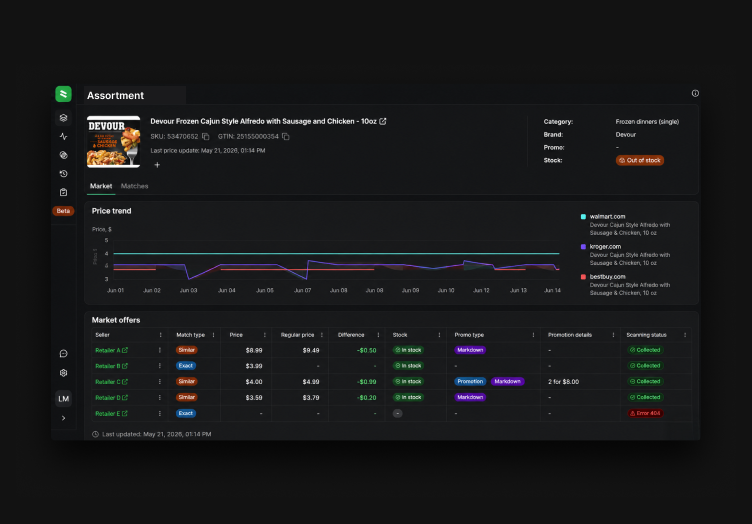
Category managers use Competera’s price monitoring software to continuously track market movements, evaluate price positioning, and competitor activity across different products and categories. Access to current market intelligence helps to identify pricing changes, promotional activity, and emerging competitive trends that may require a pricing response.

map-compliance-monitoring-for-brands-and-multi-channel-retailers

MAP compliance monitoring for brands and multi-channel retailers

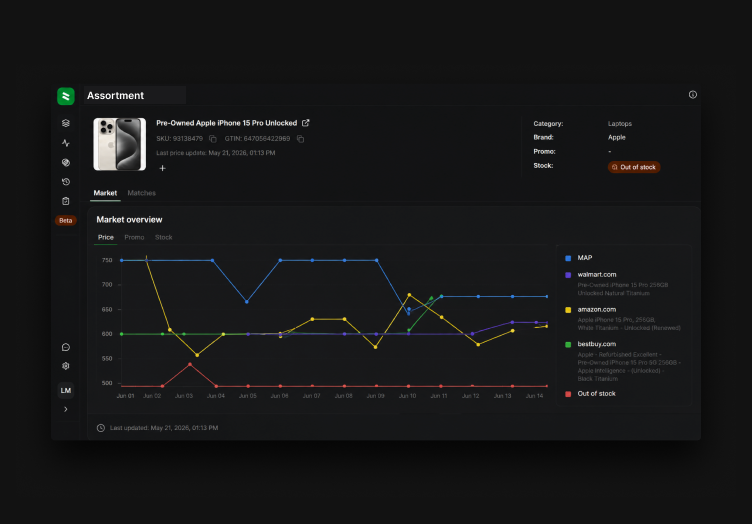
Brands and multi-channel retailers use Competera’s price scraping software to monitor product prices across retailers, marketplaces, and sales channels. This helps them to identify pricing changes, track compliance with Minimum Advertised Price (MAP) policies, and maintain great visibility into how products are priced across the market.

new-market-and-channel-expansion

New market and channel expansion

Competera helps retailers that are expanding into new markets or sales channels to gain visibility into local pricing dynamics, competitor activity, and market conditions before making pricing decisions. The solution’s reliable market intelligence helps pricing teams to better understand how products are positioned across different regions, marketplaces, and retail environments.

feeding-ai-price-optimization-with-live-market-data

Feeding AI price optimization with live market data

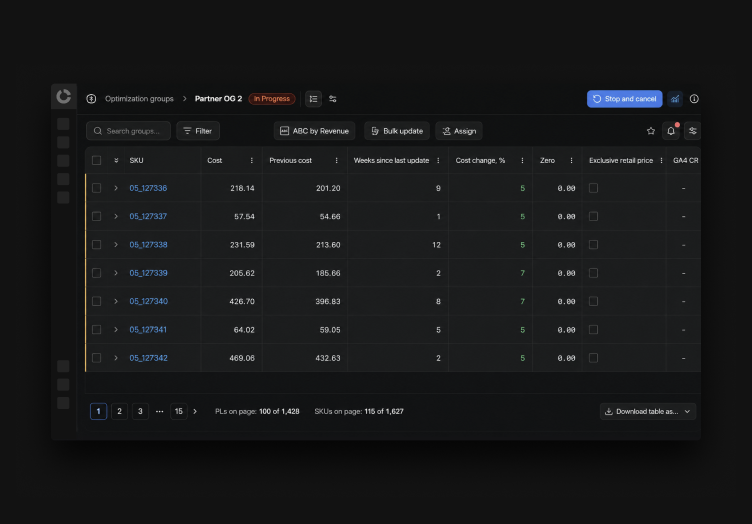
Enterprise retailers use Competera’s competitor pricing data to support AI-driven pricing strategies and optimization workflows. Competera’s continuous supply of live market data helps to ensure that the pricing recommendations are informed by changing competitor activities, market conditions, and pricing trends.

What enterprise retailers achieve with Competera

  • 119M data points delivered monthly: At this scale, Competera allows enterprise retailers to maintain visibility across large product catalogs, competitors, and markets without relying on limited market samples.

  • 2.5M product matches per month: Competera provides accurate product matching, which reduces blind spots caused by unmatched SKUs and supports reliable competitor price comparisons.

  • 34 countries tracked: Retailers use Competera to monitor competitor activity across multiple regions using consistent market intelligence and data collection standards.

  • 98.6% average matching SLA: Pricing teams can make decisions with greater confidence using competitor data that has been validated for accuracy and reliability. 

FAQ

01

What is price scraping software?

Price scraping software is a tool that automatically collects competitor pricing data from e-commerce websites, marketplaces, and other online sales channels.

02

Price scraping vs. price monitoring: what's the difference?

Price scraping refers to the data collection, automated crawling and extraction process of pricing information from competitor sources. Price monitoring software, on the other hand, is involved with the broader practice of tracking, analyzing and acting on that pricing data over time. In practice, an enterprise-grade price intelligence tool combines both functions by collecting pricing data using a price crawler and delivering structured, monitored insights that pricing teams can act on.
03

How AI-powered price scraping differs from generic web scrapers

Generic website price scrapers generally procure data based on URL patterns or page structure. They have no product understanding and only capture what can be seen on a page. This makes their enterprise-scale product comparisons unreliable. AI-powered price scraping, however, is run on AI engines and combines data collection with machine learning capabilities to identify equivalent and complementary products, detect pricing patterns, identify competitors’ KVIs, and generate deeper pricing insights from historical market data analysis.

04

Is price scraping legal?

Price scraping is legal when it involves collecting publicly available information and complies with applicable law and regulations. It is also important for retailers to ensure that their data collection practices align with website terms of use and relevant legal requirements.
05

How is Competera’s price scraping different from generic web scrapers?

Unlike generic web scrapers, Competera combines e-commerce scraping with AI-powered product matching, human validation, and multi-level data quality controls. This helps retailers to receive accurate, actionable competitor pricing data and not raw scraped information.
06

What data does price scraping software collect?

Price scraping software can collect prices, promotions, product availability, shipping information, product attributes, and other competitive market data from e-commerce websites, marketplaces, and online retailers.
07

How long does it take to set up price scraping for a new market?

The time required to set up price scraping for a new market depends on factors such as the number of competitors, products, and data requirement involved. In standard cases, Competera can launch competitive data collection within 2 weeks when the retailer has a structured catalog and the target markets are already covered by Competera.

See how Competera’s price scraping software works at enterprise scale

Competera collects accurate competitor pricing data, transforms it into actionable market intelligence, and responds faster to changing market conditions.
Talk to an Expert
Price recommendation banner