Skip to content

Pricing automation software solutions for enterprise retailers

Learn how pricing automation software replaces manual repricing cycles with AI-driven decisions that scale across store clusters, product groups, and SKUs. See how Competera helps enterprise retailers protect margin, grow revenue, and stay ahead of the market.
Talk to expert
hero-image

Why pricing automation is critical for modern retail

The nature of the economics of retail pricing has transformed dramatically. A medium-sized enterprise retailer today operates tens of thousands of SKUs across both online and offline channels, with competitors repricing multiple times per day. A manual process that could once keep price-setting under control can no longer deal with this level of complexity.

Three forces are driving the pressure on manual processing:

  • SKU complexity. Product catalogs keep growing, and pricing every SKU coherently by hand is no longer feasible.

  • Repricing frequency. Markets move in hours. Pricing workflow automation compresses reaction time from days to minutes.

  • Competitive pressure. Real-time pricing expectations have spread across every category. Slower repricing cycles are now a competitive liability.


The answer to this issue is a purpose-built pricing automation platform which can automatically handle execution in order for teams to focus on strategy instead of spreadsheet management.

What pricing automation software does

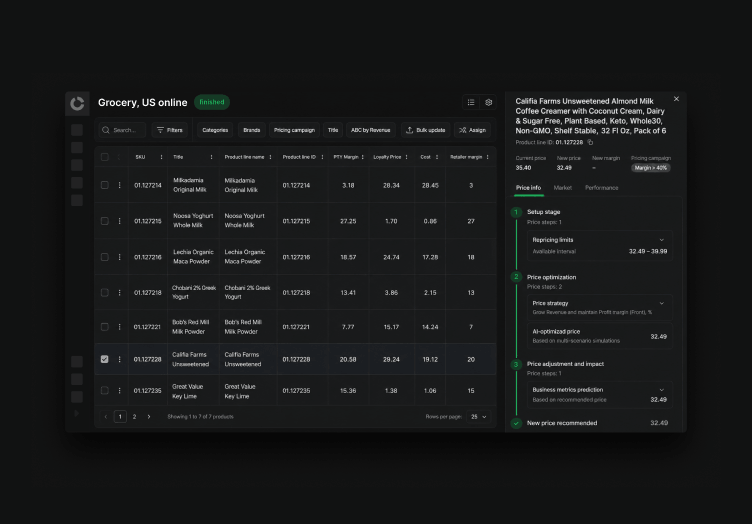
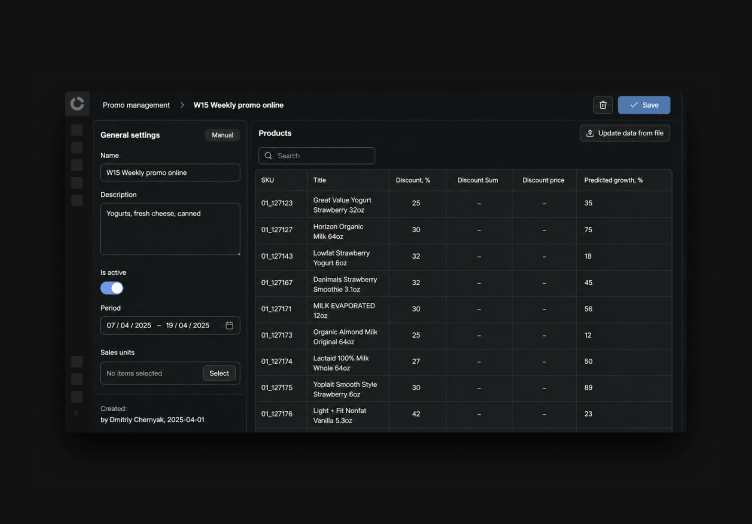
Instead of relying on manual decisions to make repricing choices in the moment, pricing automation software offers automated, data-driven repricing decisions based on current market conditions. Pricing signals (competitors, demand, costs, promotional calendars) are ingested into pricing automation software, where they’re transformed into suggestions that can be reviewed, authorized, and pushed to appropriate channels automatically without the need for hands-on input at each step.

There are two main categories of tools on the market:

3-card-items-Image-1-Rule-based-repricing-tools

Rule-based repricing tools

These solutions apply fixed logic: match the lowest competitor, stay within a margin floor. Fast to deploy, but blind to demand and cross-product effects – they often leave margin on the table or trigger unnecessary price wars.

3-card-items-Image-2-AI-pricing-automation-platforms

AI pricing automation platforms

They model demand elasticity and weigh dozens of factors simultaneously, recommending prices that balance margin, revenue, and competitive position (instead of just one of the three).

The latter is exactly what enterprise retailers at scale are looking for: a platform that reasons across the entire portfolio and delivers recommendations with all the transparency and governance controls that large organizations require.

Key challenges retailers face without price intelligence

Manual and time-consuming pricing processes

Repricing is a labor-intensive cycle when performed manually. Data export, spreadsheet model creation, approval requests, change management – all this can potentially consume 40 hours per week or more. By the time one such cycle is completed, the market itself has already moved on.

Delayed reaction to market changes

Competitor moves, demand spikes, and cost fluctuations happen regularly. Manual processes cannot catch them in time, resulting in both missed revenue when demand is strong and also unnecessary margin loss whenever competitors undercut.

Inconsistent pricing across products and channels

Inconsistencies keep accumulating each time category managers, channel teams, and regional teams set up prices independently of each other. The same product carrying different prices in different channels results in losses of both margins and customer trust.

Limited ability to scale pricing decisions

Portfolio-level pricing with cross-product interaction management, category target optimization, and balancing assortment is simply impossible to achieve at enterprise scale without the help of automation.
Competera
cta-banner-bg

Learn more about Competera’s technology

Combine competitive-driven pricing decisions with value-based pricing powered by multi-dimensional elasticity modeling

Core capabilities of a pricing automation platform

Benefits-section-Icon-1-Scenario-simulation-and-testing

Scenario simulation and testing

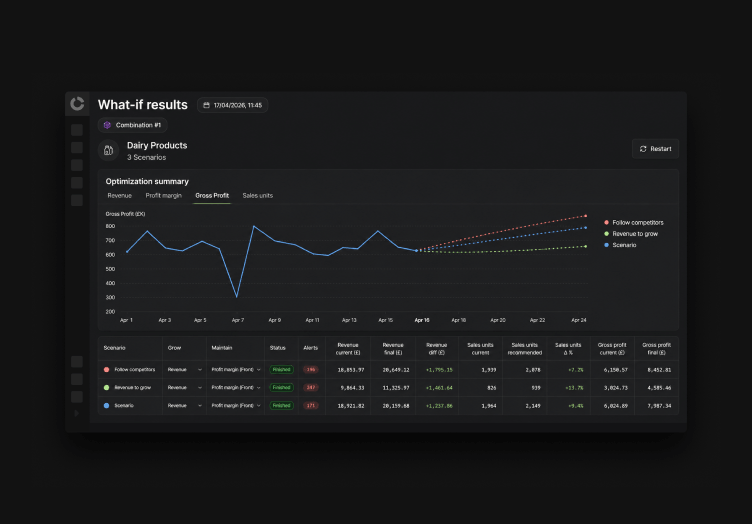
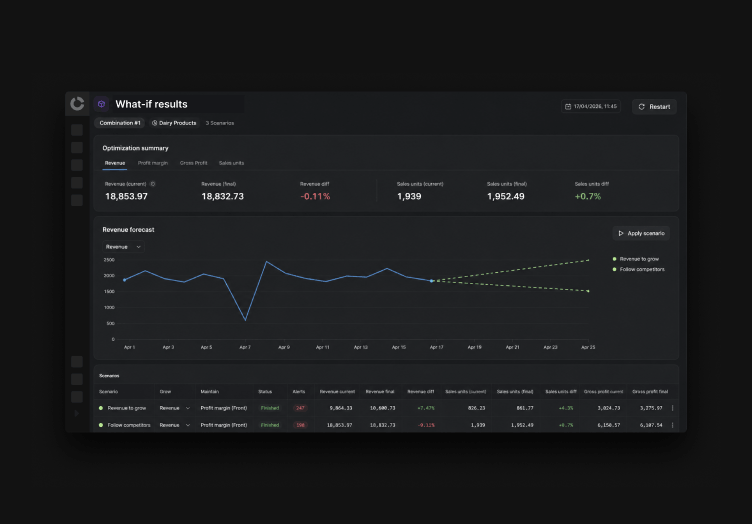
Predict the margin and revenue impact of pricing changes before committing with the help of “what-if” scenario tools. Test pricing strategies against historical demand and build confidence before committing to execution.

Explore predictive pricing
Benefits-section-Icon-2-Pricing-rules-guardrails-and-governance

Pricing rules, guardrails, and governance

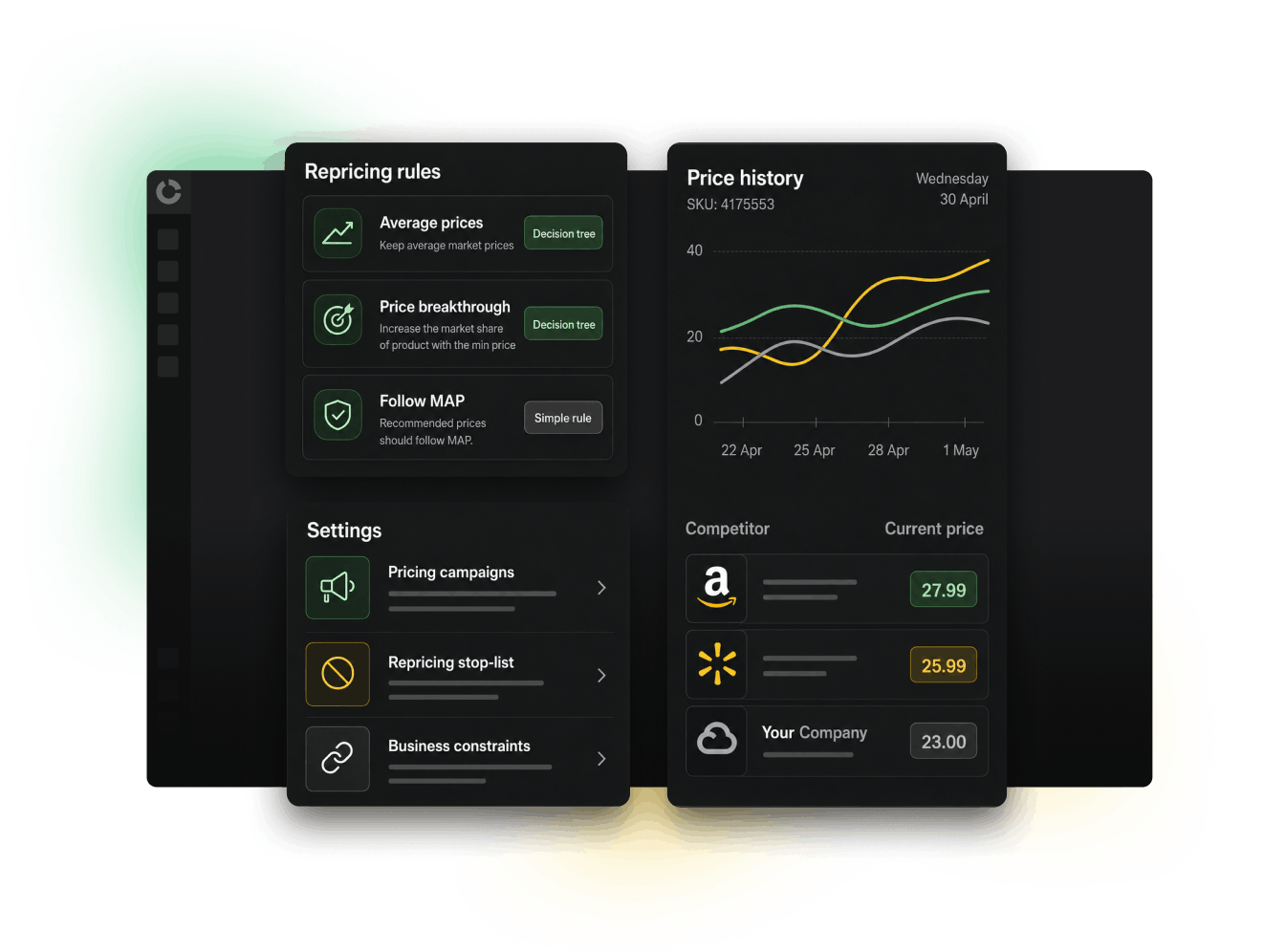
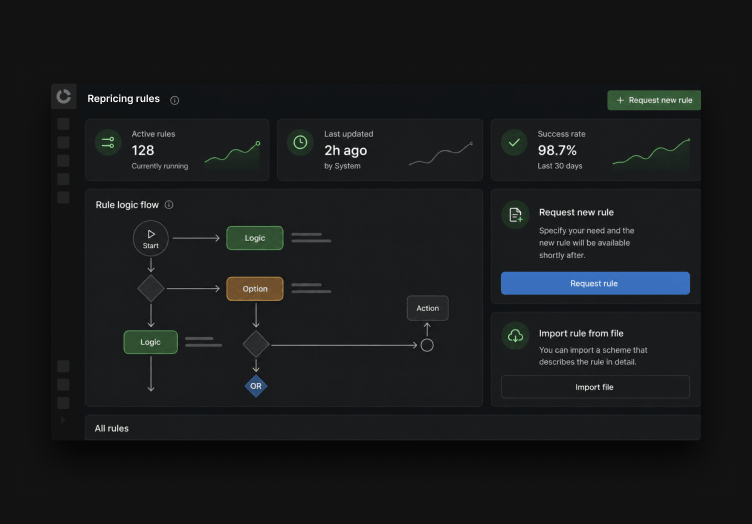
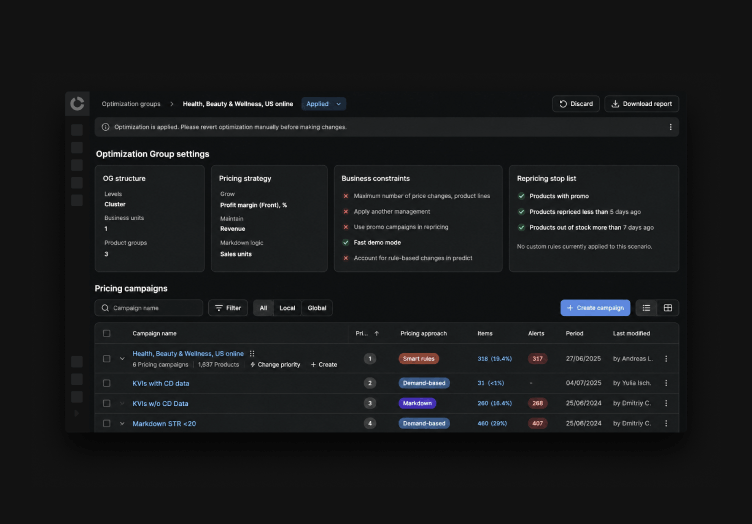
Set up rules for every SKU, product group, or store cluster (margin floors, positioning targets, brand constraints) so that automation can run transparently within a defined set of business rules.

Explore pricing models
Benefits-section-Icon-3-Cross-channel-pricing-automation

Cross-channel pricing automation

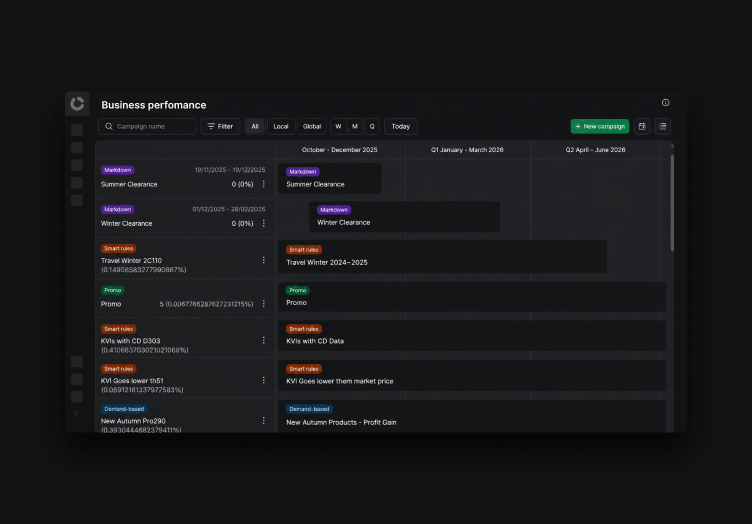
Synchronize pricing decisions across online, in-store, mobile, and marketplace channels – with the ability to make channel-specific adjustments where strategy demands it.

Explore omnichannel pricing

Key use cases for pricing automation software

Image-2-Automating-daily-repricing-workflows

Automating daily repricing workflows

The highest-impact starting point for most enterprise-grade retailers is to automate the daily repricing cycle. Transitioning price updates from spreadsheets to automated workflows saves dozens of hours each week – a time that could be redirected toward strategy and commercial planning.

Use-cases-2-Supporting pricing-teams-with-AI-decision-making

Supporting pricing teams with AI decision-making

The bottleneck in most pricing operations is not the calculation. It is getting new prices updated and aligned across retail systems, channels, and stores. Automating that process frees pricing teams to focus on strategy rather than synchronization.

Use-cases-3-Responding-to-competitor-price-changes

Responding to competitor price changes

Continuous competitor surveillance reveals recommendations that maintain your market position without sacrificing margins. Faster response translates into fewer lost sales, fewer unnecessary price concessions, and less reactive decision-making performed under pressure. When it comes to retailers in highly-competitive categories, this alone can be the difference between leading in terms of price perception and being stuck playing catch-up all the time.

Use-cases-4-Scaling-pricing-decisions-across-large-catalogs

Scaling pricing decisions across large catalogs

A catalog of 50,000 SKUs cannot be managed meaningfully at a product level by a manual process. From company-wide goals down to individual SKUs, pricing strategies can be easily configured and adjusted at any level, applied instantly across the entire catalog. Store clusters, product groups, and portfolios are all supported, with changes taking effect as soon as they were made.

How Competera pricing automation works

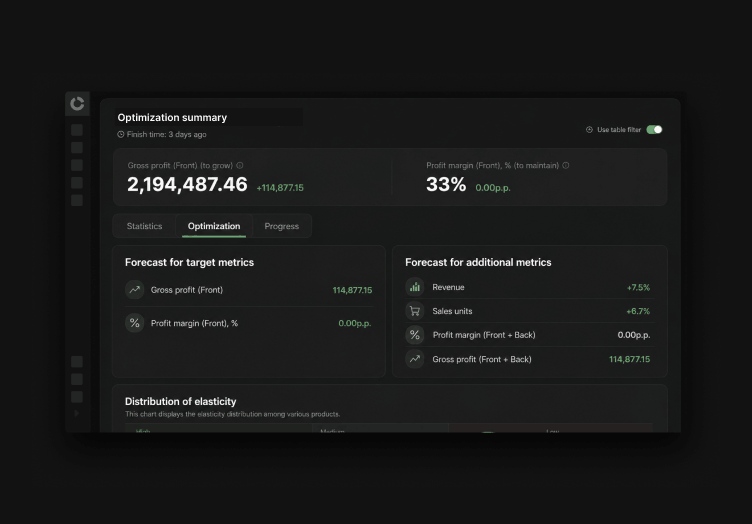
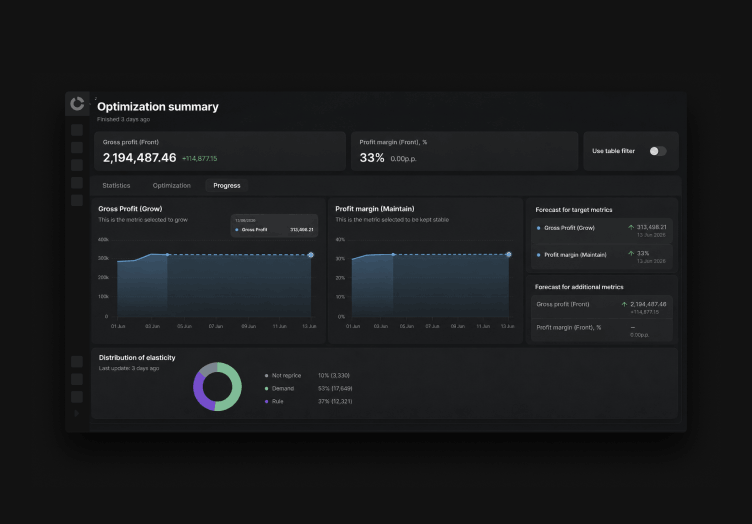
Competera's pricing automation platform brings market intelligence, demand modeling, and execution together into a single workflow – making price recommendations consistently grounded by current data and acted on at the speed the market demands.
How-Competera-works-1-AI-driven-price-optimization-engine

AI-driven price optimization engine

The core of Competera Pricing Platform is a deep learning model trained using billions of real-world transactions. It estimates elasticity of demand, models cross-catalog price effects, and weighs 20+ contextual factors such as procurement costs, seasonality, and local competitive dynamics. All of this leads to recommendations that are not just reactive but predictive of how the customers are going to respond.

How-Competera-works-2-Automated-pricing-workflows-across-the-portfolio

Automated pricing workflows across the portfolio

Price recommendations are only valuable if they are transparent, aligned with business goals, and taking action on them does not involve manually changing every SKU. Competera's automation layer connects recommendations and actions by creating rules, setting up approval processes, and defining guardrails that only need to be configured once.

How-Competera-works-3-Real-time-price-recommendations-and-execution

Real-time price recommendations and execution

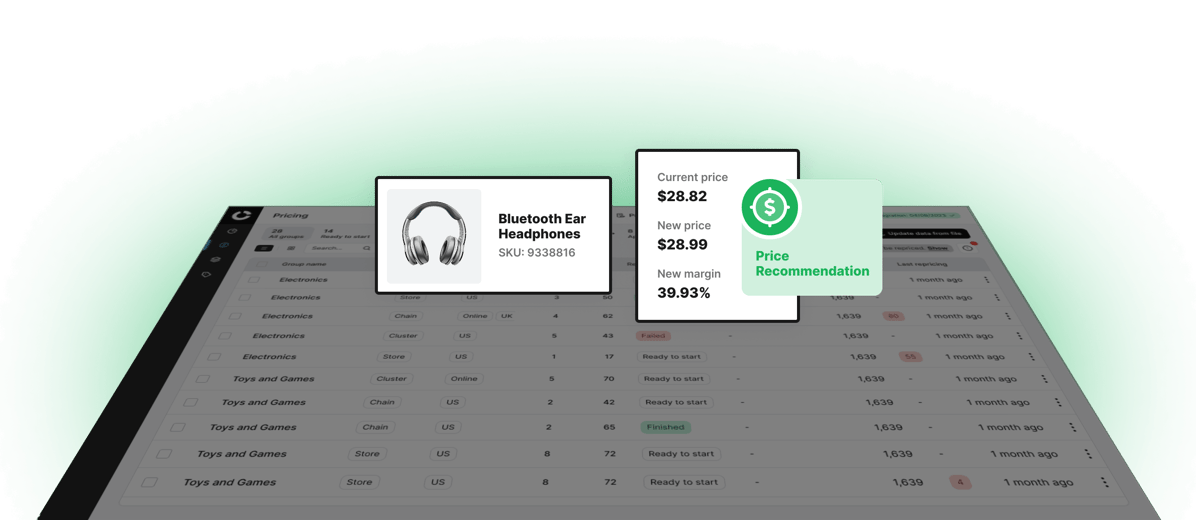
Competera offers recommendations on the fly based on changing inputs (competitor moves, costs, demand) and pushes approved prices to channels at the speed the market demands. Repricing time drops from 60 hours per week to less than four.

Benefits of pricing automation for retailers

  • Faster repricing cycles. From days to minutes, keeping prices current as markets move.

  • Reduced manual workload. Recover 40+ hours per week currently spent on routine execution.

  • Improved pricing accuracy. AI accounts for more factors than any manual process can.

  • Increased revenue and margin. Competera customers see an average 6% margin uplift and 8% revenue growth.

  • Better market responsiveness. Competitor moves and demand shifts reflected in prices within minutes, not days.

  • Operational efficiency. Consistent cross-channel pricing and transparent workflows reduce coordination overhead.

FAQ

01

What is pricing automation software?

Pricing automation software is a platform replacing manual price-setting with automated, data-driven processes. It continuously ingests market signals and generates recommendations that can be reviewed and executed without manual intervention at every step.
02

How does automated pricing work in retail?

Data inputs (competitive intelligence, sales history, cost data, promotional calendars, elasticity coefficients, weather, holidays, etc.) flow into the pricing engine that calculates SKU-level recommendations, filters them by pre-defined rules and guardrails, and pushes approved prices to channels automatically.
03

What is the difference between repricing and price optimization?

Repricing is reactive by nature. It monitors competitor prices and triggers adjustments based on predefined rules (such as “always undercutting the lowest competitor by 2%”). It automates simple logical rules, but the logic in question has its limitations. It optimizes for only a single variable and ignores everything else that happens in the market.

Price optimization, on the other hand, is proactive. It relies on demand modeling and algorithms as the means of finding the price that achieves a specific objective, whether it’s maximizing revenue, margin, or market share. It can factor in demand elasticity, customer segments, inventory levels, and seasonality, which helps it treat competitor prices as one input among many.

04

How fast can pricing automation update prices?

With Competera, retailers typically cut their repricing cycle from 40–60 hours per week to less than four hours. This is a reduction of more than 90%, with price recommendations updating dynamically in response to market fluctuations.

Automate pricing decisions with AI

No matter if your focus is on quicker repricing, margin recovery, or scaling to a larger catalog, Competera’s platform has been designed to deliver measurable results from day one.
Talk to an Expert
Price recommendation banner