



Key takeaways
- Competitive pricing analysis evaluates the underlying strategy and rationale behind competitors' price movements, whereas price monitoring simply records current market prices.
- For retailers managing extensive SKU (Stock Keeping Unit) assortments, minor pricing variances directly affect bottom-line P&L (Profit and Loss) performance, making structured analysis essential.
- Competitive pricing analysis consists of six sequential stages: defining competitor tiers, prioritizing high-impact SKUs, collecting verified data, mapping price index gaps, identifying behavioral patterns, and simulating outcomes.
- Blindly matching competitor price reductions without evaluating internal demand elasticity frequently results in margin erosion.
- Enterprise-scale analysis requires automated scraping and AI-driven simulation tools to maintain data freshness, verify product-matching accuracy, and project the financial impact prior to implementation.
Retailers today have access to more competitor price data than at any point in history. Yet most pricing teams still react to market moves rather than anticipate them, adjusting prices after a competitor acts rather than operating from a strategy grounded in their own demand signals.
To help teams shift from a reactive mindset to a proactive advantage, this guide breaks down what competitive pricing analysis is, how to run a structured six-step process, and how to turn that data into a competitive pricing strategy that drives margin growth.
What is competitive pricing analysis?
Competitive pricing analysis is the process of collecting, comparing, and acting on competitors' pricing data to inform your pricing decisions. It covers direct competitors, indirect competitors, and pricing signals across all channels, online, in-store, and marketplace.
For large retailers managing thousands of products across many markets, this analysis is the foundation of a lasting competitive pricing strategy, distinguishing between merely reacting to the market and gaining a true competitive advantage.
Competitive pricing analysis vs. price comparison: what's the difference?
The difference between competitive pricing analysis and basic price tracking and monitoring is in the depth of interpretation. Price monitoring is passive collection: you know what a competitor charges today. Competitive pricing analysis is a continuous, full-assortment process that explains why they charge that price, what it signals about their strategy, and exactly how your business should respond. Price monitoring tells you what, but competitive pricing analysis tells you why and what to do next.
| Metric | Price comparison | Competitor pricing analysis |
| Scope | Single SKU, single point in time | Full assortment, ongoing |
| Output | A data point | A strategic decision |
| Depth | Current market price points | Strategic intent and response mapping |
| Frequency | Ad hoc | Continuous or scheduled |
A practical retail example: a grocery retailer running weekly price checks on 500 items to execute their Key Value Item (KVI) pricing strategy is doing a price comparison.
In contrast, competitive price analysis involves building a strategy based on competitor behavior patterns across categories. This process requires figuring out which competitors use basic staples to attract shoppers, which ones are aggressive with their own store brands, and when they typically launch their big sales.
Why competitive pricing analysis matters for enterprise retailers
For retailers operating at $1B+ in annual revenue, pricing at scale carries material financial risk. A 1% pricing error across 50,000 SKUs directly hits the P&L.
Structured competitor price analysis surfaces three specific market dynamics:
- Where your business is priced out of the market and losing traffic.
- Where products are under-priced, resulting in a leaked gross margin.
- Where competitor pricing movements signal broader market shifts that require a strategic response.
Each of these factors directly influences long-term revenue trajectory and market share, establishing a distinct competitive advantage for teams that track them.
Revenue and margin impact
Based on Competera data, retailers that use AI-driven tools alongside structured competitive analysis see +3–7% revenue growth and +2–5 pp gross margin uplift.
Pure competitor-matching tactics, such as automatically following or undercutting rivals without evaluating internal demand signals, can erode margins as quickly as they generate revenue. Incorporating price sensitivity data for each SKU ensures competitive insights protect profitability rather than compromise it.
A competitor's price reduction is only actionable when data confirms that matching the move will drive meaningful volume. This is why competitive pricing analysis must inform strategy rather than replace it.
How to conduct a competitive pricing analysis: 6 steps
Conducting a rigorous competitive pricing analysis follows six sequential steps: defining the competitive set by tier, identifying and prioritizing high-impact SKUs, collecting verified market data, calculating price index gaps, detecting competitor behavioral patterns, and simulating the financial impact of strategic pricing rules before deployment.
When this systematic, six-step process is followed, pricing teams get the reliable customer demand data and price sensitivity information they need to protect their market share and avoid unnecessary profit loss.
1. Define your competitive set
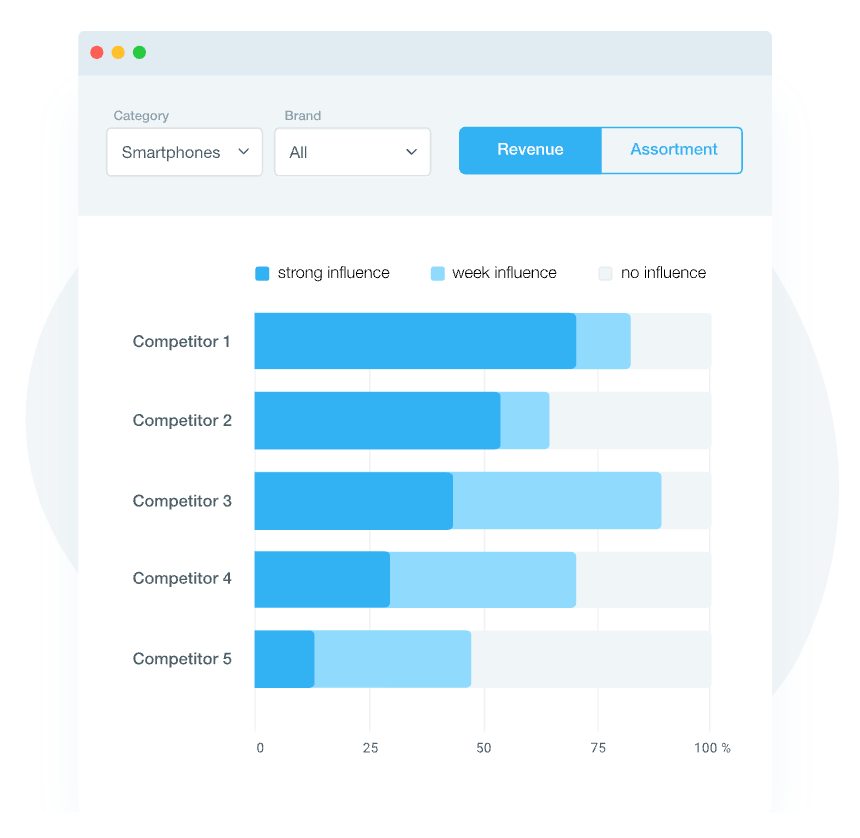
Enterprise retailers must categorize competitors at the category level rather than the brand level, as competitive relevance shifts by product type. Review and update this mix at least quarterly to account for new regional players or marketplace entrants.
Divide the market into three specific tiers:
- Primary: Direct competitors targeting identical customer segments with a matching product assortment.
- Secondary: Competitors operating on adjacent price tiers, such as premium or value brands, who influence customer reference prices.
- Tertiary: Companies with partial assortment overlap are useful for category management and future expansion planning.
2. Identify the SKUs that matter most
Instead of analyzing your entire product assortment, focus your resources on high-impact items that most heavily influence traffic, customer conversion, and average basket value. This priority list should begin with your Key Value Items (KVIs). KVIs are the baseline products customers use to judge your overall price competitiveness, making them the essential starting point for competitive analysis.
3. Collect and quality-check competitor price data
The methods for collecting data should be based on your company's size. Manual collection via spreadsheets and mystery shopping is sufficient for smaller product selections with infrequent updates.
However, large retailers managing over 10,000 SKUs across multiple regions should use automated solutions such as price-scraping tools, price tracking software, and competitive data platforms. Data quality must be monitored against three distinct failure points to prevent misleading information:
- Incorrect product matching: Comparing products that are not identical (e.g., different sizes or volumes) results in inaccurate price comparisons. This is resolved using automated tools that match products and human experts who validate edge cases.
- Outdated data: Relying on outdated data (such as checking prices weekly for items that change daily) causes the business to fall behind the market. You must update your price data as often as prices typically change in that product category.
- Missing market coverage: Leaving out prices from regional competitors or online marketplaces creates serious informational gaps.
To eliminate these gaps, enterprise retailers require an infrastructure capable of handling massive scale. For example, Competera’s price scraping software establishes the enterprise benchmark by delivering 119 million data points monthly across 34 markets, operating under a 99% product matching quality SLA and a 98% average delivery SLA to ensure data reliability.
4. Analyze price positioning and gaps
Calculate your price index against each defined competitor tier to determine your relative market position as a ratio across your SKU set. This process highlights three primary pricing patterns:
- Consistently over-indexed SKUs: Products priced higher than competitors, which risks losing customer traffic or hurting price perception on important items.
- Consistently under-indexed SKUs: Products priced lower than necessary, resulting in unforced margin leaks.
- Erratic SKUs: Volatile price movements that indicate a competitor clearing stock, entering the market below cost, or managing inventory uncertainty.
A price index diagnostic is only useful when combined with price elasticity. While the index shows your market position, demand elasticity data reveal how sensitive your customers are to that position. Understanding both allows you to make strategic pricing decisions that capture demand and protect your profit margins.
5. Identify competitor pricing strategy patterns
Looking at price changes over time reveals how your competitors actually operate, which is where competitive intelligence begins. Instead of just tracking what they charge today, analyze their historical data to answer practical operational questions:
- Are they running a competition-based pricing approach, or does their pricing respond dynamically to demand signals?
- Are they a price leader in specific categories, or do they follow market moves?
- How frequently do they change prices?
- What is their markdown cadence? Is it a controlled seasonal clearance or reactive discounting?
- Does their pricing differ by channel, and does it shift before peak trading periods?
Understanding these patterns transforms raw data into forward-looking intelligence. It reveals whether matching a competitor's move is a response to a genuine strategic signal or a reaction to noise.
These insights also feed your own pricing rules: if a key competitor consistently undercuts on specific KVIs before peak periods, your response can be pre-set and automated rather than scrambled in real time.
6. Build your response strategy and simulate before you act
The output of competitive pricing analysis is a set of strategic rules: when to match a competitor's move, when to hold your position, and when to lead. Sound competitive analysis and pricing discipline together determine the correct path for each SKU tier.
Define parameters for each SKU tier. On KVIs, you may target a price index within a defined range of your primary competitor. On convenience items, you may hold or price above market to protect gross margin. On seasonal items, you may lead early markdowns to protect sell-through.
Before executing any large-scale price change, run pricing simulations. By modeling the financial impact on your products before committing, you transform simple analysis into a proactive strategy. This ensures that your pricing decisions are based on predicted results rather than unexpected losses discovered after the fact.
For instance, a retailer considering changes across 500 SKUs should never have to guess the outcome; reviewing the modeled P&L impact in advance gives them full financial clarity before the new prices go live. This is where competitive pricing analysis graduates into a competitive pricing strategy built on evidence rather than instinct.
 Competitive pricing strategies for retail — examples by vertical
Competitive analysis varies by retail vertical. The underlying process is the same, but the data priorities, competitive set, and pricing response differ significantly across categories. The following verticals illustrate how competitive pricing analysis translates into specific strategic decisions for enterprise retailers.
- Grocery retail. Grocery retailers typically operate under two primary models: Everyday Low Price (EDLP) or Hi-Lo promotional pricing. Competitive analysis helps you identify which Key Value Items (KVIs) must match competitor prices exactly to protect your price image, and where you have room to flex pricing without changing customer perception.
A standard industry pattern is to match rivals dollar-for-dollar on high-frequency staples like milk, bread, and household basics, as these products heavily influence how shoppers judge your overall store prices. At the same time, you can protect your margins on private-label lines where direct competitive pressure is lower. Tracking these metrics also alerts you the moment a competitor shifts their promotional schedule or discounts a major category anchor, allowing your pricing team to execute a planned response rather than react on gut instinct. - Consumer electronics retail. Electronics pricing environments move incredibly fast. High-visibility products like TVs, laptops, and gaming hardware are repriced daily, sometimes multiple times per day, on major marketplaces. This rapid pace makes real-time price tracking and elasticity modeling essential for maintaining market position.
Automatically matching a competitor's price drop on a Key Value Item (KVI) without analyzing demand sensitivity can severely damage profitability. If data shows that a competitor's lower price is not driving incremental sales volume in that category, copying their price cut results in pure margin erosion for no volume benefit.
Furthermore, competitive analysis in this sector must account for Minimum Advertised Price (MAP) policies. For brand-authorized products, your ability to differentiate on base price is structurally limited. Because of these constraints, competitive intelligence shifts away from base-price positioning and focuses instead on tracking promotional timing, product bundling, and inventory availability gaps. - Health and beauty retail. Competitive pricing analysis in the health and beauty sector primarily operates at the brand-tier level. For major national brands, such as established skincare and cosmetics lines, retailers typically maintain near-parity pricing with key competitors to protect their price image among brand-loyal shoppers. In contrast, own-brand and exclusive products offer significantly more pricing flexibility, allowing retailers to control their margins directly.
Large beauty retailers leverage these dynamics to build a balanced category pricing structure. They keep high-visibility national brands competitively priced to drive store traffic, then lean on their exclusive lines to generate actual profitability. This framework protects overall gross margin across the full assortment without compromising the price perception that brings shoppers through the door.
Common challenges in competitive pricing analysis — and how to fix them
Operationalizing competitive pricing analysis at an enterprise scale consistently surfaces four distinct challenges, each requiring a specific operational fix. We explore each of them below:
Data coverage gaps. Scraped data that misses marketplace sellers, regional players, or specific zip codes produces an incomplete competitive picture. To resolve this, establish clear delivery SLAs and minimum match-rate benchmarks prior to vendor selection, ensuring these requirements are legally binding in the provider's contract.
Product matching errors. Comparing different product variants, like pack sizes, colors, or bundle configurations, as if they are the exact same SKU is the most common source of false market signals. To solve this at enterprise scale, retailers use automated product matching equipped with confidence scoring, paired with human validation to review complex edge cases.
Acting on stale data. Using weekly data in a category where rivals run dynamic pricing on daily cycles means your analysis is structurally reactive. Match data refresh frequency to the repricing cadence of each category. Treating all categories the same is both an efficiency problem and an accuracy problem.
Competitive myopia. Optimizing purely against competitors' prices, without anchoring decisions to your own demand signals, turns competitive analysis into a margin-erosion tool rather than a margin-protection tool. The fix is to always pair competitive positioning data with price sensitivity and demand elasticity data. Matching a competitor's price is only a good decision when you understand the volume response that match will produce.
How AI improves competitive pricing analysis at scale
Artificial intelligence improves competitive pricing analysis by automating data workflows and predicting the financial outcomes of price changes before they go live. While manual competitive analysis is sufficient for a small assortment of 200 SKUs, the process becomes unmanageable for enterprise retailers balancing 20,000 or more SKUs across multiple markets and channels.
AI pricing software resolves these scale limitations across four critical operational stages:
- Enterprise data collection: Automating raw data gathering across thousands of digital channels simultaneously.
- Product matching accuracy: Utilizing machine learning to match identical items precisely, which drastically reduces false market signals.
- Behavioral pattern detection: Sifting through millions of historical data points to uncover the hidden strategies behind competitor price movements.
- Real-time recommendations: Merging fresh competitor data with internal demand signals to generate calibrated, auditable pricing actions.
The strategic value of predictive simulation
The most important capability for enterprise pricing teams is predictive simulation, which allows users to see the exact revenue and margin impact of a pricing move before executing it. This framework relies on a human-in-the-loop model powered by explainable AI.
Instead of functioning as a black box, the technology surfaces the clear business reasoning behind every recommendation. This ensures that pricing teams retain full operational control, relying on data to make informed decisions rather than gut-feel calls.
For a deeper look at the implementation process, read our AI pricing guide tailored specifically to enterprise retail.
Case in point
A leading luxury cruise retail operator managing 89 premium ships streamlined its complex global pricing by deploying Competera’s Contextual AI solution. The biggest operational challenge for this retailer was that their stores were constantly moving, meaning their direct competitors changed every time a ship docked at a new port. If onboard prices became misaligned for even a single day, captive passengers would simply wait to shop at onshore duty-free stores instead.
Competera solved this volatility by building a dynamic system that automated location-based pricing rules tied directly to each ship’s specific itinerary. The platform consolidated competitor data across regions into a single unified currency dashboard, enabling the team to execute complex, multi-market adjustments instantly.
A nine-week pilot of this solution successfully delivered a 30% increase in daily profit per passenger while simultaneously wiping out 80% of the pricing team’s manual workload.
These results are made possible by the Competera Pricing Platform, which delivers an ongoing forecast accuracy rate of over 95% for revenue and margin impacts, with the operational agility to scale to new regions or digital channels within a single week. This predictive power is supported by Competitive Data, Competera's enterprise scraping infrastructure, which processes 119 million data points monthly across 34 markets while maintaining a 99% product matching quality SLA.
See how the Competera Pricing Platform connects competitive data to strategic pricing decisions. Speak to our experts to learn how your business can benefit with Competera.