Competitive Pricing Basics
A competitive pricing strategy is a pricing approach when retailers use other players’ prices as a benchmark for their own pricing.
This strategy is often referred to as competitor-based pricing and can be considered within the broader concept of market-driven pricing. The basic formula for a competition-based price might look as follows.
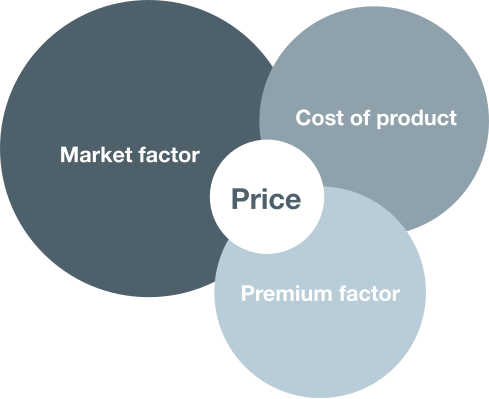
The ‘market factor’ here stands for competitive and any other market data referenced by a retailer while ‘premium factor’ marks the money equivalent charged for exclusive services or product features. As you might see, the main factor of building a successful strategy is the data about your competitors – not necessarily just about prices. Factors that influence the competitive pricing start from your awareness about competitors’ product cards (descriptions, images) to knowledge about delivery times, service offers, etc. However, what you should know for sure is that this type of strategy is crucial for players working or going online. Moreover, Retail Playbook for Stores Post COVID-19 by Gartner says that the winning strategy is to optimize your workforce via hybrid human & machine labor portfolio.
Why does your business need competitive pricing?

Key to success
Ensure that every pricing decision relies on relevant data and focus on what matters for your company's growth. Moreover, using data-proof decisions excludes the human factor.

Use any data as a variable
Your pricing logic can be built upon any data including competitive data from direct sellers or marketplace (e.g. Google shopping), sales, cost data, Google Analytics data, promotion or stock clearance attributes, etc.

Stay competitive
Make sure your margin is not diluted by following unnecessary competitors. Advanced algorithms reveal the true impact every player has on sales by analyzing retailer and competitive historical data.

Market-driven approach
Utilizing a competitive pricing strategy is the cornerstone for building a holistic and effective market-driven pricing powered with pricing rules and customizable decision trees to get full control over each product in your portfolio.
How to monitor competitors prices?

According to Total Retail’s 2020 Retail Technology Report, retailers are making a priority to use technology to help them better market to customers in 2020 and beyond. Moreover, two-thirds of retailers said they will be increasing spending on technology in the next 12 months. The right combination of a tool and a task creates synergy helping businesses grow even in the hardest of times. How? These pages will answer how data collecting software works.
Price tracking software
Price scraping software
Price crawling software
How to analyze pricing data
Collecting the fresh and right data is just the tip of the iceberg because something has to be done with it. Let's look at examples.

Competitive Pricing Analysis
Retailers that can analyze market data, map their position against competitors, and offer optimal prices are the companies that catch buyers’ eyes first and foremost. It's important, especially when we’re witnessing a surge in demand for online orders and delivery services, with orders during the first week of March 33% higher compared to that same week in 2019 (accordingly to Gartner). This article will help you understand how to implement competitive pricing analysis software to your business.
This article will help you understand how to implement competitive pricing analysis software to your business.
Use any data as a variable
Your pricing logic can be built upon any data including competitive data from direct sellers or marketplace (e.g. Google shopping), sales, cost data, Google Analytics data, promotion or stock clearance attributes, etc.
Stay competitive
Make sure your margin is not diluted by following unnecessary competitors. Advanced algorithms reveal the true impact every player has on sales by analyzing retailer and competitive historical data.
Market-driven approach
Utilizing a competitive pricing strategy is the cornerstone for building a holistic and effective market-driven pricing powered with pricing rules and customizable decision trees to get full control over each product in your portfolio.