










Why Artificial Intelligence in Retail Is No Longer Optional
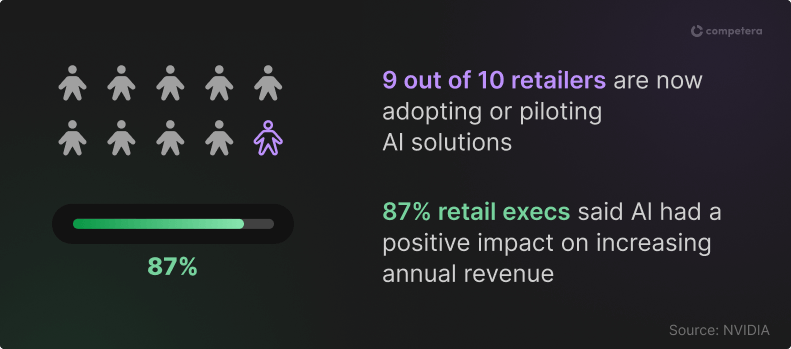
Factors that drive AI adoption processes in retailMarket research indicates that AI in retail industry adoption is accelerating at a rapid pace. The latest State of AI in Retail and CPG report by NVIDIA, shows that 90% of retailers either use AI solutions or test them while 87% of C-level executives report AI has already generated additional annual revenue.
The combination of macroeconomic factors, rising consumer expectations, and intensifying market competition is nudging retailers to explore AI solutions – especially now that the recent technological advancements make it possible to implement AI in a way that balances business objectives, customer demands, and privacy regulations.
An average enterprise retailer stores over 23B files – roughly 10 petabytes of data. As consumers demand personalized experiences and best prices, while shareholders expect to see revenue growth, healthy margins, and operational efficiency, AI becomes a strategic answer to this two-fold challenge.
What AI retail solutions are
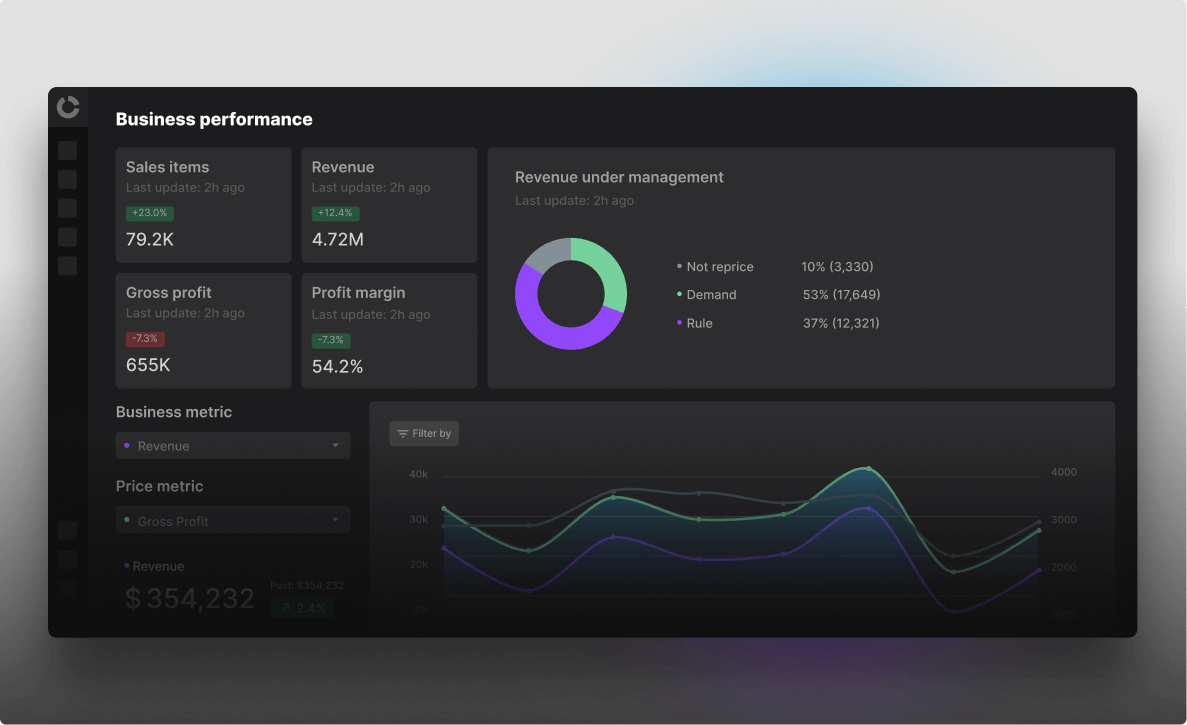
AI retail solutions are software platforms that use artificial intelligence and machine learning to analyze large volumes of retail data and generate actionable insights. These solutions process signals such as sales history, customer behavior, competitor pricing, and external factors to support smarter pricing strategies, demand forecasting, inventory management, promo campaign planning and execution, supply chain analytics, etc.
By integrating AI into their workflows, retailers can:
- Optimize pricing strategies based on demand signals and market conditions
- Improve demand forecasting and anticipate shifts in customer behavior
- Enhance inventory management to reduce stockouts and overstocks
- Leverage supply chain analytics to improve operational efficiency
- Respond faster to competitor price changes and market dynamics
Retail Challenges AI Solves
From macroeconomic pressure and increasing market competition to changing consumer expectations| Misaligned pricing strategies | Inconsistent omnichannel experiences | Low-ROI promotions | Ineffective key value item (KVI) management | Inaccurate finance planning |
| Retail AI solutions bridge the gap between your pricing strategy and revenue targets. Competera Pricing Platform responds to market shifts in near real-time by analyzing demand drivers such as price elasticity, product lifecycle, and competitor pricing. The platform protects margins without damaging price perception. | Misalignment between offline and online prices increases cart abandonment rates. AI solutions for retail create a centralized pricing system that standardizes prices across stores, regions, and channels. With Competera, retailers can quickly simulate outcomes based on demand drivers and implement consistent price changes across multiple touchpoints. |
General promotions and low-return campaigns lead to unnecessary margin loss. Competera aligns your promotional strategies with actual customer demand, competitor actions, and inventory levels to implement highly effective campaigns that achieve revenue targets. | Poor pricing strategies for assortments diminish turnover and profitability. Competera Pricing Platform identifies your KVIs and optimizes their prices to enhance market perception and attract customer traffic while ensuring profit margins on the remaining assortment. |
Finance teams often make critical pricing and promotion decisions without clear visibility into ROI or financial risk. With Competera, retailers can move away from reactive planning by simulating the exact impact of pricing decisions on margin, revenue, and sell-through before implementation. |
Top use cases for AI-driven retail pricing
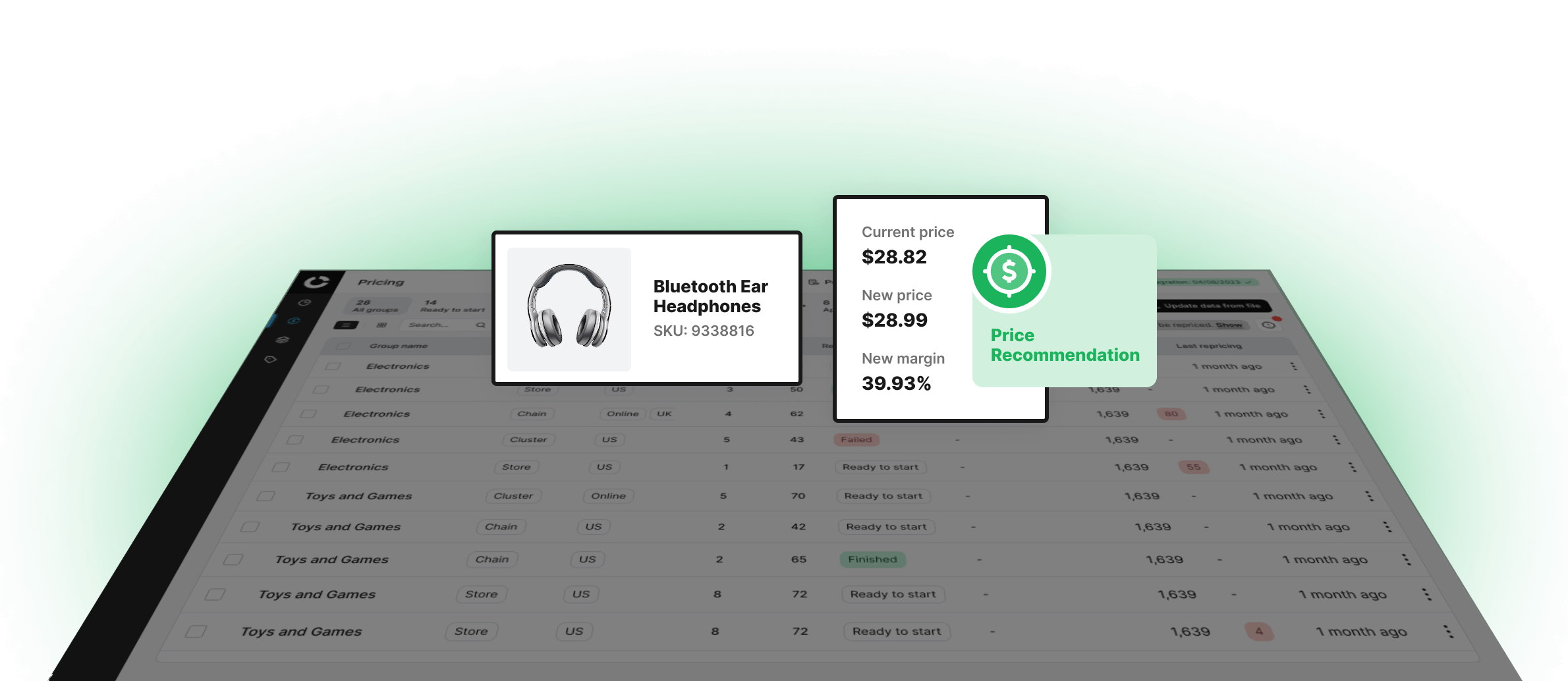
Artificial intelligence is the operating system of the modern retail business. Competera shifts your pricing from manual guesswork to an integrated capability that balances market competitiveness with profit margins.
Here are the primary pricing strategies enterprise retailers automate with our retail AI solutions:
| Omnichannel pricing | Dynamic pricing | Personalized promotion marketing |
| Provide consistent, customer-focused pricing across all online, mobile, and in-store touchpoints. By monitoring channel-specific price elasticity, retailers can ensure pricing consistency that builds customer trust while minimizing margin losses across different channels. | Traditional pricing was rigid. Retail AI solutions, like Competera, allow retailers to adjust pricing in nearly real-time right after a particular pricing or non-pricing factor changes. It can be an increased consumer demand, a competitor’s move or even a change of the weather. | Retail and artificial intelligence come together most visibly in marketing. Instead of sending generic promotions, AI retail solutions can build highly offers. A shopper browsing sports shoes receives a personalized campaign, while a loyal grocery buyer gets bundle discounts that actually fit their habits. The result is stronger conversion and higher basket value. |
| Customer analysis | Predictive analytics | Competitive & market-based pricing |
| The benefits of artificial intelligence in the retail industry include sharper insights into shopper journeys. AI in retail business can map not just what customers buy, but when and why. It highlights lifetime value, signals churn risk, and suggests interventions that build loyalty and trust. | Demand forecasting has always been a pain point in retail. Now, AI for retail makes it possible to predict demand down to SKU level, helping teams order smarter and reduce waste. | Compete with precision, not broadly. Use detailed market intelligence alongside value-based modeling to clearly identify when a competitor's price change requires a response. |
Building an AI-driven retail infrastructure
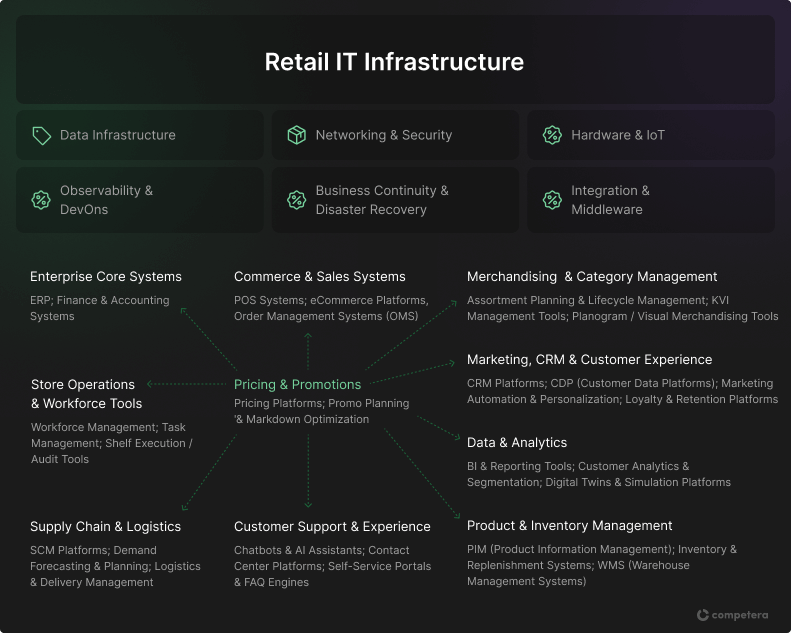
To implement effective pricing strategies, your operational data must lead to immediate decisions. This is where AI solutions like Competera come in.Large-scale retailers operate complex IT infrastructure that consists of ERP systems, POS networks, product catalogs, inventory management solutions, supply chain platforms, customer data systems, and many others. While these systems generate massive volumes of operational and customer data, many retailers still lack a layer of intelligence that turns this data into profitable pricing actions
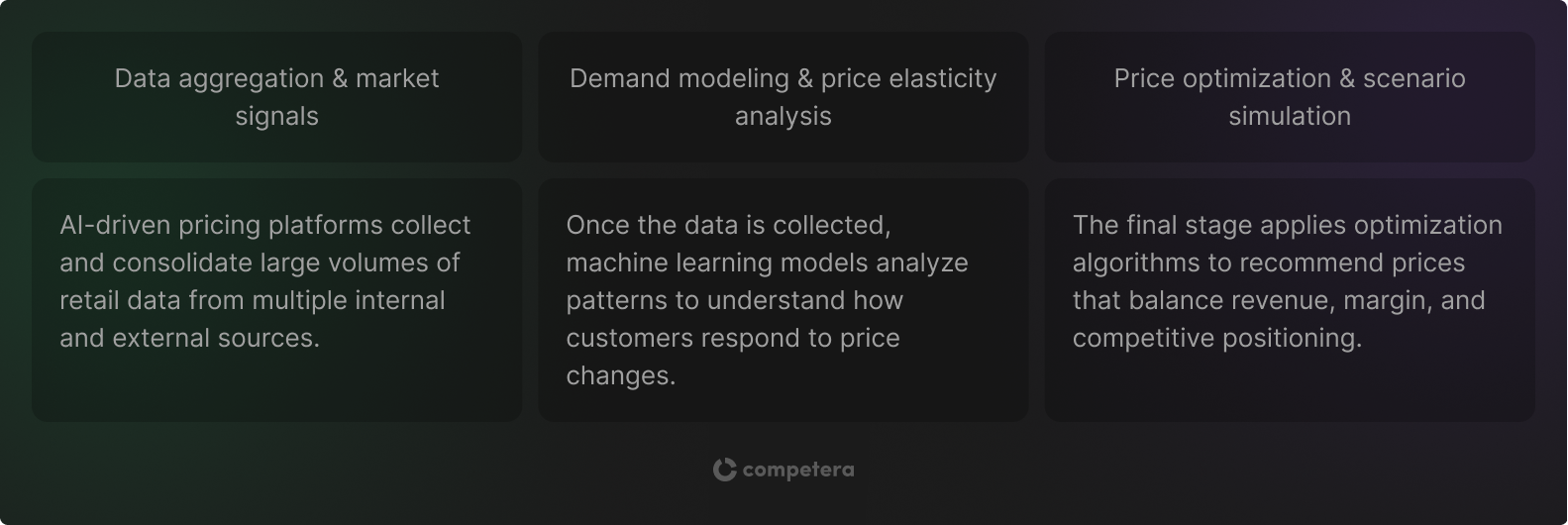
Competera is designed to seamlessly integrate into your existing retail tech infrastructure, combining first-party data with over 20 external demand factors to deliver real-time, context-aware pricing decisions. Rather than replacing your core systems, Competera enhances them with predictive intelligence designed specifically for retail.
Benefits of AI-Driven Pricing Solutions
Retailers adopting AI retail solutions like Competera achieve measurable improvements across revenue, margins, and operational efficiency:
- +3–7% revenue growth from optimized pricing strategies
- +2–5pp margin improvement through demand-driven pricing
- 50–70% reduction in pricing workload through automation
- Faster pricing decisions with real-time market response
- Better demand insights through AI elasticity modeling
- Stronger customer trust leading to higher basket value and CLTV
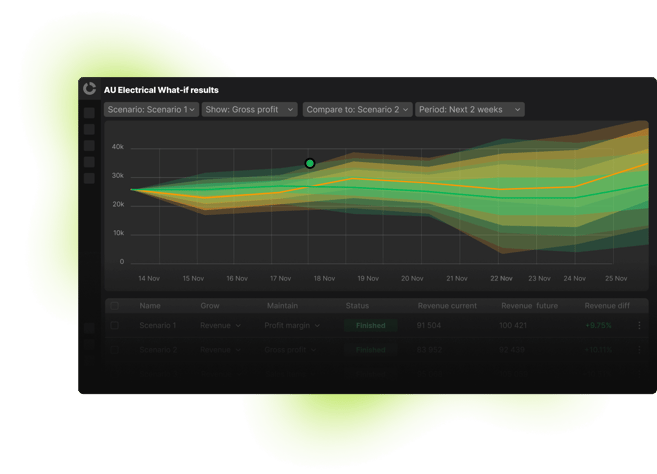
What makes Competera different is its Contextual AI engine, which enables retailers to run What-If simulations and predict the business impact of pricing decisions with 95%+ accuracy before implementing them.
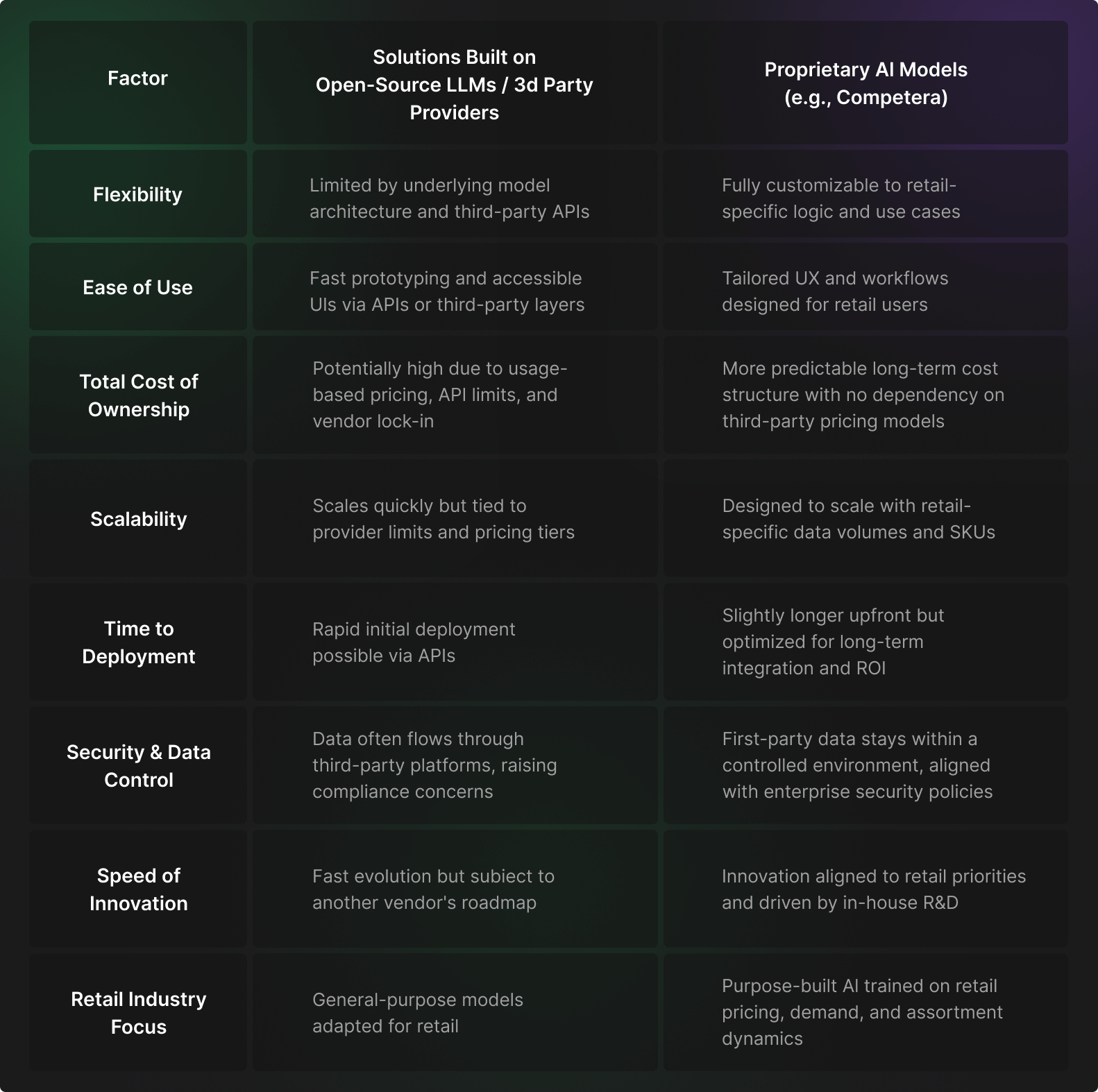
Retail Solutions Built on Open-Source LLMs vs. Proprietary AI Models
Many AI-powered retail solutions on the market today are built on third-party large language models or open-source foundations. While these tools may offer fast deployment, they also introduce hidden risks: shifting usage policies, rising costs, data dependency, and even the possibility of platform deprecation.
Competera takes a different approach.
Our proprietary AI models are built in-house, trained specifically on retail pricing data, and fully maintained by our engineering and data science teams. That means our clients are not reliant on external vendors to power critical pricing decisions. They get full transparency, long-term stability, and a solution designed for retail, not repurposed from another domain.